
 Search within the site


1
Overview
An illuminance spectrophotometer disperses measured light to acquire detailed spectral data. This enables accurate measurement not only of illuminance but also of chromaticity and color rendering indices, and allows measurement of parameters such as the peak wavelength of light-emitting diodes (LEDs). In addition to illuminance and chromaticity management for indoor and outdoor lighting, illuminance spectrophotometers are used to manage illumination sources employed for adjustment, calibration, and inspection of optical equipment such as projectors and camera modules. In recent years, as projectors have achieved higher contrast and image sensors have become more sensitive, the importance of improving the accuracy and speed of low-illuminance measurements has increased. In addition, sensing technologies using near-infrared light are widely used in applications such as autonomous driving and facial recognition, creating a need to manage the peak wavelength and irradiance of near-infrared light sources. To address these challenges, we developed the illuminance spectrophotometer “CL-700A” (Fig. 1), which expands the measurable illuminance range compared with previous models, enables high-speed measurement at low illuminance, and supports irradiance measurement in the near-infrared region.
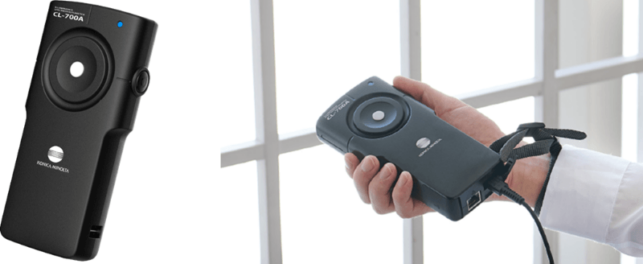
Fig. 1 Illuminance Spectrophotometer CL-700A
2
Details
■Configuration
The CL-700A is an illuminance spectrophotometer that provides high accuracy in compliance with standards related to illuminance meters. The instrument is designed for stable operation not only in laboratories but also on production lines and supports Power over Ethernet (PoE) connectivity in addition to USB. This enables stable long-distance communication and power supply. Up to 15 units can be connected via PoE, and measurement can be controlled using the supplied application software “CL-S30,” supporting illuminance management at multiple points (Fig. 2). Using CL-S30, various light-source evaluation metrics required in laboratories and production lines—such as color rendering index (CRI), TM-30, equivalent melanopic lux (EML), standard deviation of color matching (SDCM), and photosynthetic photon flux density (PPFD)—can be calculated, displayed, and saved.
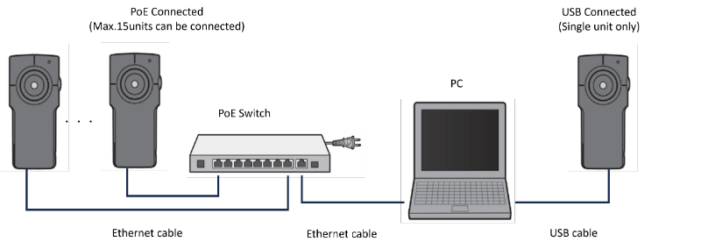
Fig. 2 System Overview Diagram
■Functions / Features / Applications
With a newly developed built-in spectrometer, the CL-700A achieves higher sensitivity, a more compact design, and near-infrared measurement compared with the previous illuminance spectrophotometer “CL-500A.” Illuminance can be measured down to 0.01 lx and chromaticity down to 0.5 lx, allowing measurement at one-tenth the illuminance of the CL-500A. In terms of measurement speed, the instrument measures 0.1 lx in approximately 2 seconds, compared with approximately 27 seconds for the CL-500A. This contributes to improved accuracy in light-source management for projector adjustment and inspection (Fig. 3), inspection of light sources for image sensors and camera modules, and shorter production process.
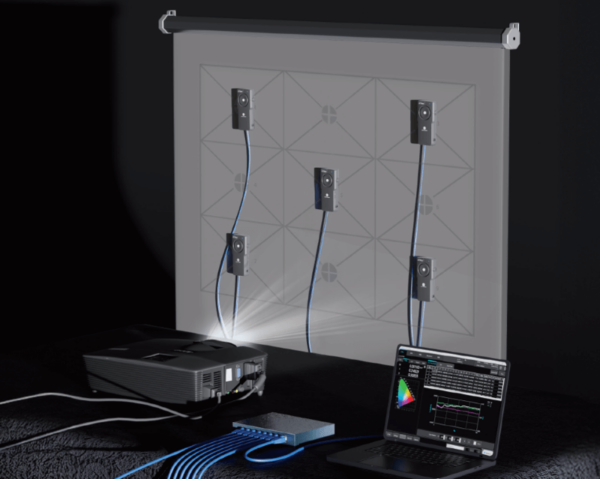
Fig. 3 Usage Example for Projector Evaluation
With spectrometer miniaturization, the instrument depth (from the rear of the instrument to the measurement reference plane) matches that of the illuminance meter “T-10A” and chroma meter “CL-200A.” This facilitates installation in confined spaces and enables combined use with or replacement of the T-10A and CL-200A. The measurement wavelength range is 360 nm to 1000 nm, covering the commonly used 850 nm and 940 nm bands in the near-infrared region and enabling a single unit to support both visible and near-infrared applications.
The CL-S30 operates on Windows and macOS and enables batch setting of measurement conditions and measurement for one unit via USB and up to 15 units via Ethernet. Measurement results can be reviewed in list form as well as through various metrics and graphs and can be exported as comma-separated values (CSV) files (Fig. 4). The supplied communication specifications also enable control using user-developed software.
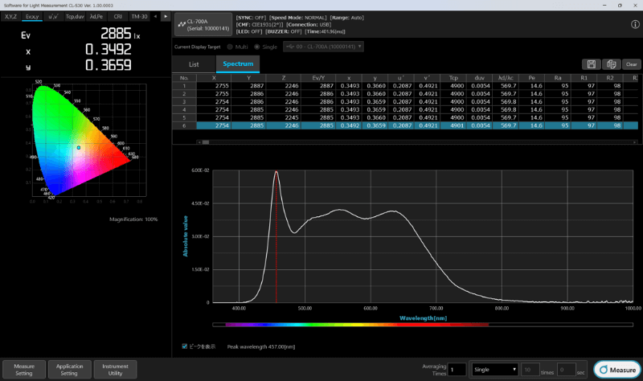
Fig. 4 Application software CL-S30
■Future outlook
This paper introduced the functions and features of the illuminance spectrophotometer “CL-700A.” Konica Minolta will continue developing technologies that deliver the performance and functions required at light-source management sites, thereby contributing to resolution of customer issues.