
 Search within the site


1
Overview
Following the agreement at the 26th Conference of the Parties to the United Nations Framework Convention on Climate Change (COP26) to reduce methane emissions by 30% from 2020 levels by 2030, the United Nations Environment Programme (UNEP) launched the Oil and Gas Methane Partnership 2.0 (OGMP2.0), a framework for reporting and managing methane-gas emissions. More than 150 major oil and gas companies worldwide participate. Under these initiatives, the use of Optical Gas Imaging (OGI) cameras has expanded in recent years to visualize methane leak locations.
Conventionally, leak points were identified using an OGI camera and the leak rate was measured using a high-flow sampler. Because a high-flow sampler is a 10-kg-class device carried by an operator during site patrols and requires gas suction, it cannot measure leaks at elevated locations. Konica Minolta developed a flow-rate estimation function that quantifies leak rates from infrared images and incorporated it into the handheld gas leak inspection system camera “GMP02” (Fig. 1 left) 1).
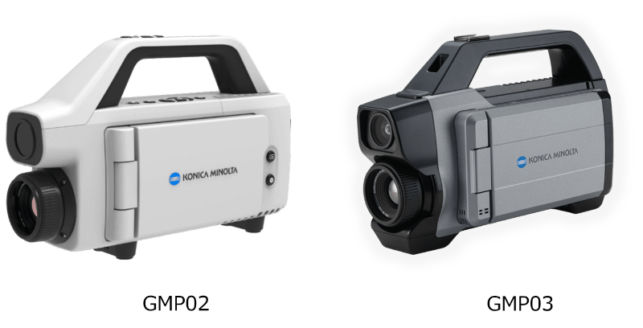
Fig. 1 Gas Camera System GMP02 & GMP03
To further improve customer operations, the next-generation model “GMP03” (Fig. 1 right) eliminates the need for external devices such as a PC or tablet, which were required to use the flow-rate estimation function on the previous model “GMP02,” enabling standalone operation using only the camera. In addition, the model improves gas-visualization image quality, enhances the flow-rate estimation function, and improves operability, including Bluetooth support 2).
2
Details
■Configuration
“GMP03” uses a cooled infrared sensor for gas visualization. Proprietary image-processing technology provides multiple image modes, including gas-enhanced images that improve gas visibility, and allows simultaneous recording of these modes. Leak-rate quantification requires distance data from the camera to the gas; Bluetooth linkage enables automatic acquisition of this data from a rangefinder. While improving robustness, the camera achieves the world’s lightest weight among cooled OGI cameras (as of October 1, 2025) and improves operability.
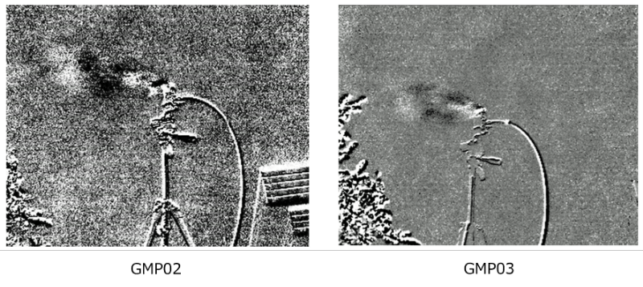
Fig. 2 Image Qaulity Improvement.
■Functions / Features / Applications
For gas visualization, sensor noise was reduced through sensitivity adjustment and related measures to improve high-sensitivity image quality. As shown in the transition from Fig. 2 (left; conventional GMP02) to Fig. 2 (right; GMP03), the visibility of faint gas improved. The flow-rate estimation function was also enhanced by outputting a representative value and a reliability level (Fig. 3). On the conventional “GMP02,” quantified values were output every 5 seconds, requiring inspectors to select a single flow-rate value from multiple outputs. Poor sensitivity could cause underestimation, while excessive noise could cause overestimation. In “GMP03,” the camera analyzes the shooting scene and weather conditions and outputs a representative value with expected accuracy rather than a simple average. The system also displays reliability in three levels based on the analysis results, allowing inspectors to objectively assess the result and make on-site decisions such as repositioning the camera for improved sensitivity and reshooting.
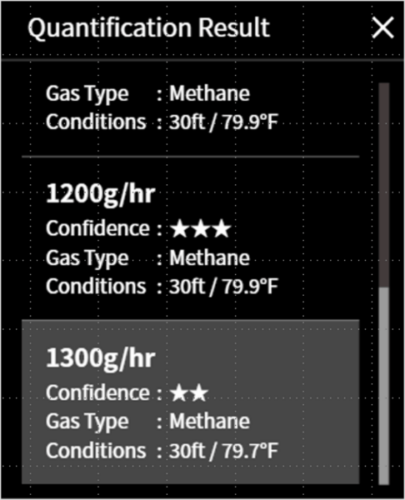
Fig. 3 Representative Value and Reliability of Quantification.
To use the flow-rate estimation function, the previous model “GMP02” required an external device such as a PC or tablet. In contrast, “GMP03” improves the user interface to ensure that the entire operation can be completed with the camera alone (Fig. 4). Gas leak inspection and gas quantification are often performed by a single inspector, and reducing the number of devices to carry improves customer convenience.
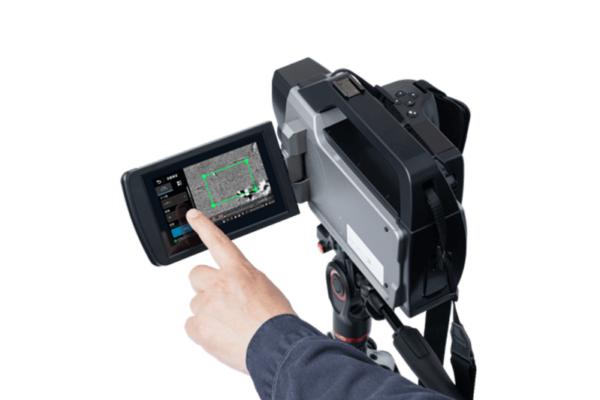
Fig. 4 A single camera completes the entire process from leak inspection to quantification.
The grip can be rotated to adjust the angle according to the shooting scene. The camera is equipped with buttons for starting/stopping recording and switching among multiple image modes, enabling shooting while operating the camera with one hand while holding the grip (Fig. 5).
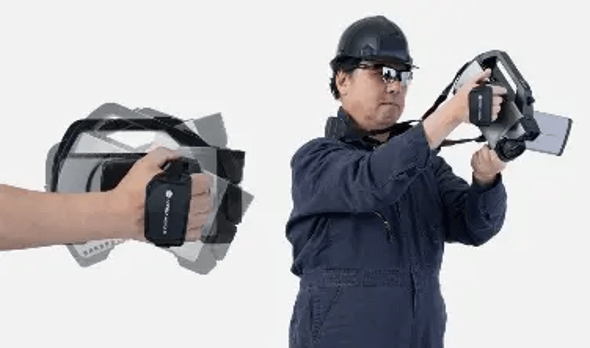
Fig. 5 The repositionable grip in the hand-held area improves operability.
■Future outlook
The flow-rate estimation function has conventionally targeted relatively small-scale unintentional leaks. Going forward, we aim to expand its applicability so that it can also estimate large-scale gas releases such as venting and blowdown with high accuracy. We will further enhance quantification technology and promote linkage with other technologies, evolving it into a technology capable of measuring leak emissions across the entire oil and gas industry and continuously driving expansion of applications.