


1
Overview
Far-infrared cameras are expected to play an important role in advanced driving assistant systems (ADAS) because they can detect pedestrians as heat sources even under low-visibility conditions such as nighttime, dense fog, and rain. However, optical systems for automotive far-infrared cameras are typically expensive and bulky, as they require multiple germanium lenses. This has become a significant barrier to broader adoption in automotive applications. As a potential solution, metalenses1), next-generation optical elements that precisely control light by arranging micro- to nanoscale structures on a substrate surface, have attracted considerable attention. Unlike conventional lenses, which control light through refraction by curved surfaces, metalenses are planar optical elements with thicknesses of only several micrometers. Despite its thin structure, it is expected to achieve optical performance comparable to, or even exceeding, that of conventional lenses. This report introduces a metalens currently under development that leverages Konica Minolta’s core technologies in optics and nanofabrication to enhance the performance of far-infrared cameras while reducing cost.
2
Details
■Configuration
By varying the dimensions and shapes of subwavelength microstructures, their interaction with light can be controlled. For example, as shown in Fig. 1, light transmitted through a thin pillar structure (A) propagates faster, whereas light transmitted through a thick pillar structure (B) propagates more slowly. When the pillars are arranged with a spatial gradient in width (C), the propagation speed of light differs between the peripheral and central regions, resulting in a metalens that focuses the transmitted light. Accordingly, in metalens design, it is essential to appropriately determine the dimensions and shapes of the microstructures at each coordinate.
As of 2025, commercially available metalens design software typically improves performance by constraining microstructure shapes (e.g., to cylindrical pillars) and searching for an optimal diameter at each coordinate. However, if such constraints are removed and the shape itself is treated as a design parameter, higher-performance metalenses can be realized. The authors developed in-house software capabilities for microstructure-shape parameterization and tolerance-aware design, enabling higher-performance and more distinctive metalenses. Figure 2 shows beam profiles on the image plane for a metalens with a focal length of 1 mm, comparing a fixed-shape design with a variable-shape design (a mixture of seven cross-sectional shapes, such as rectangles and hexagons) and a high-tolerance design. The results indicate that shape parameterization and incorporation of tolerance considerations lead to improved focusing performance.
Fig.1 Conceptual diagram of propagation-speed variation of light transmitted through microstructures and focusing by a metalens
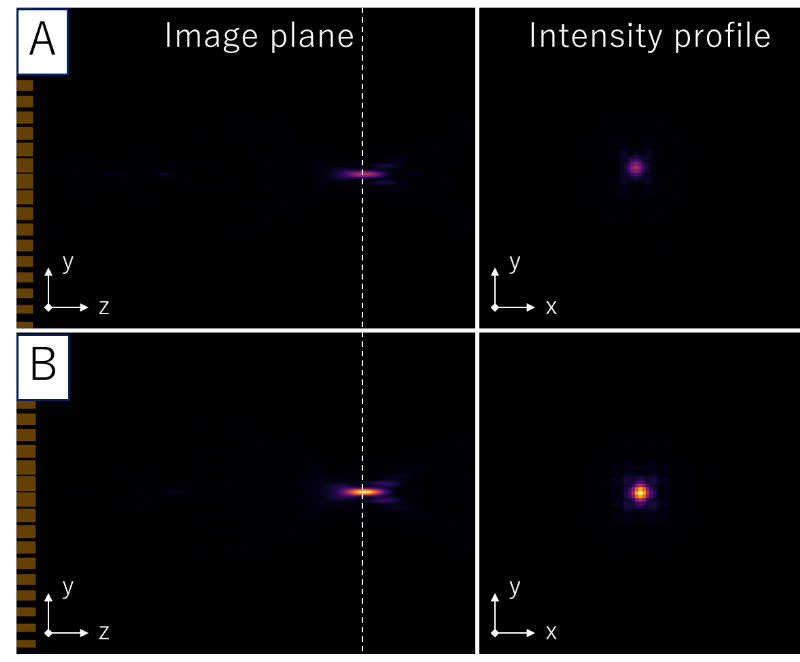
Fig.2 Comparison of beam profiles on the image plane for light transmitted through a metalens (A. fixed-shape design vs. B. variable-shape, tolerance-considered design)
■Functions / Features / Applications
Because metalenses can be fabricated using semiconductor manufacturing processes such as photolithography and etching, they offer advantages in mass producibility and cost compared with conventional lenses. Additionally, Konica Minolta possesses nano-fabrication technology as a core competency, enabling end-to-end in-house prototyping of metalenses within a short period of time. Figure 3 shows scanning electron microscope images of the fabricated pillar-shaped microstructures . By optimizing processing conditions, high-aspect-ratio microstructures with aspect ratios of 1:10 or higher and excellent verticality have been realized. This high-precision nano-fabrication technology enables fabrication of metalenses that exhibit the intended optical functions as designed.
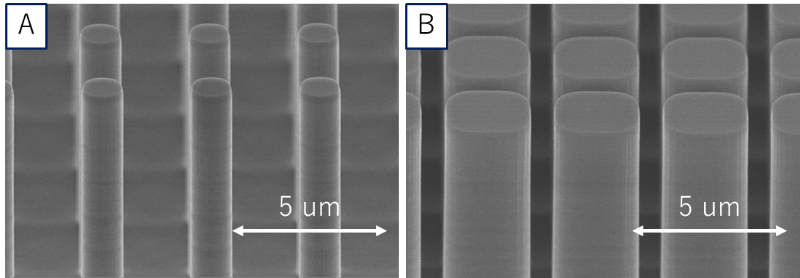
Fig.3 Electron microscope image of high-aspect-ratio microstructures
■Future outlook
Conventional far-infrared cameras have relied on aspheric germanium lenses, which are costly and associated with significant procurement risk. As an alternative, we fabricated a hybrid metalens optical system that combines an inexpensive spherical silicon lens with a metalens and investigated the feasibility of achieving high image quality without the use of germanium2). Figure 4 compares images obtained using a spherical silicon lens alone with those obtained using the same lens combined with a metalens that corrects aberrations equivalent to those addressed by an aspheric lens. The results show that the addition of the metalens suppresses blur, particularly in the peripheral field of view (red frame in the figure), and improves image contrast. Going forward, we will expand the application of metalens technology to fields requiring miniaturization, higher precision, and lower cost, including automotive far-infrared cameras, thereby contributing to the realization of a safer and more secure society through technologies that visualize the invisible.
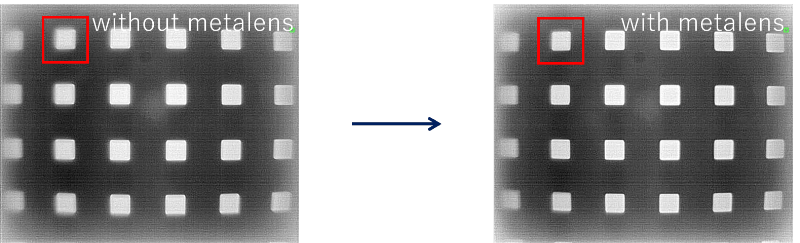
Fig.4 Comparison of image contrast between a silicon lens alone and a hybrid metalens