


1
Overview
For over 20 years, Konica Minolta has contributed to the transformation of textile printing from analog to digital through its Nassenger series of inkjet textile printers. In digital textile printing, a pretreatment step, in which a pretreatment solution is applied to fabric prior to printing, is required to promote dye fixation. This step is one of the factors that increases the overall manufacturing process burden.
To reduce this burden, Konica Minolta advanced the development of an inline pretreatment ink that can be jetted by inkjet. In July 2025, Konica Minolta launched an inline pretreatment ink for reactive dyes, “O’ROBE” (hereinafter referred to as “the product”). By using the product, the pretreatment step can be integrated into the printing step. This substantially reduces energy consumption and eliminates the need for inventory management of pretreated fabric. As a result, the product can significantly contribute to reducing environmental impact and improving customer work efficiency (Fig. 1).
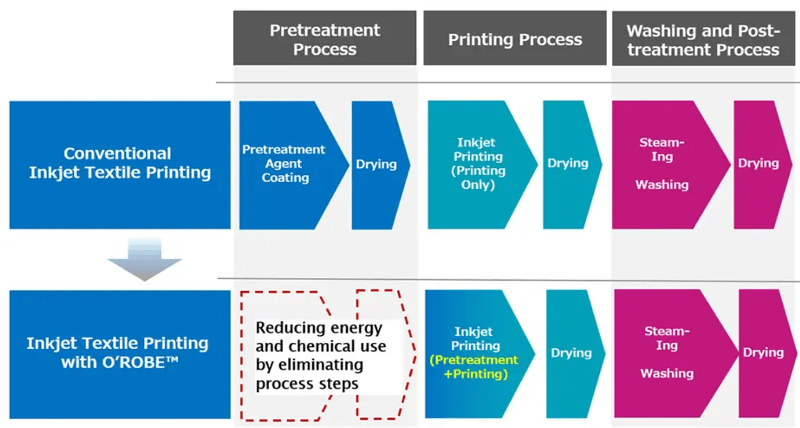
Fig. 1 Process flow of digital textile printing
2
Details
■Configuration
The product is a functional ink that can be installed on the Nassenger series as a pretreatment ink for reactive dyes for textiles, enabling integration of the pretreatment and printing steps. Pretreatment is an essential element in digital textile printing, as it allows dyes to properly adhere to the fabric, preventing degraded print quality (Fig. 2). The product is designed to be jetted by inkjet while maintaining the functions required of conventional pretreatment solutions.
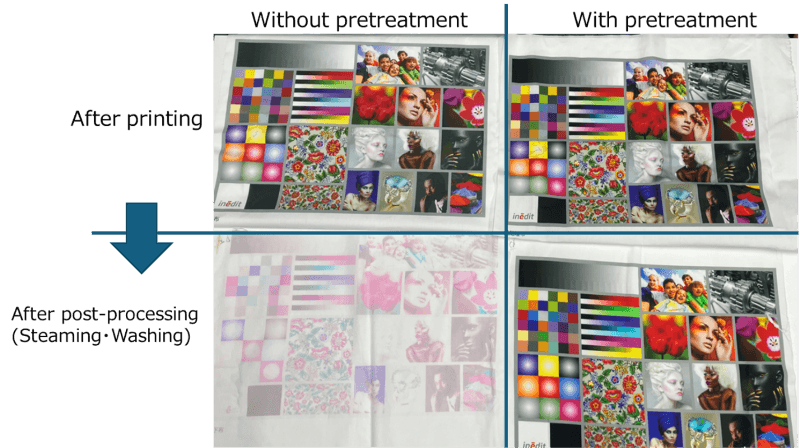
Fig. 2 Role of pretreatment
■Functions / Features / Applications
The following section introduces the inkjet-enablement technologies for pretreatment solutions that are critical to the product.
Achieving both high concentration and printhead durability
Pretreatment solutions generally contain an alkaline agent to promote dye fixation. However, because the applied amount of pretreatment ink in the inkjet method is smaller than that in the conventional padding method, the concentration of the alkaline agent must be increased. Simultaneously, alkaline agents are one of the factors that can cause failures in inkjet printheads, and simply increasing the concentration has been difficult from the standpoint of printhead durability. By optimizing the alkaline agent used, the product achieves both high concentration and printhead durability (Fig. 3).
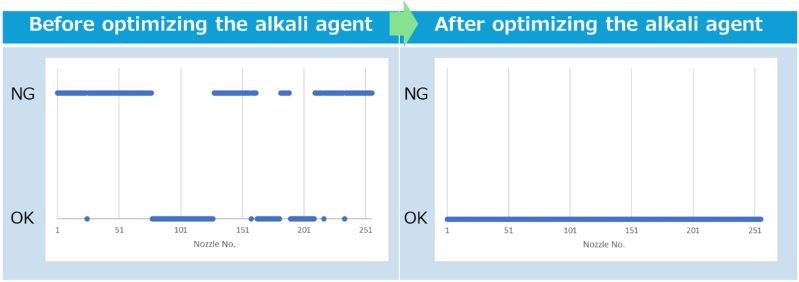
Fig. 3 Nozzle conditions in an inkjet printhead before and after alkaline-agent optimization
Improving ink storage stability
Typically, inkjet inks have a storage life of 1 to 2 years from manufacture. Under alkaline conditions, however, inks containing humectants may undergo humectant decomposition. As a result, the performance of pretreatment inks containing humectants can deteriorate, making it difficult to secure a sufficient storage period. To address this issue, we developed a technology to prevent humectant decomposition within the ink, thereby ensuring a sufficient storage period (Fig. 4). By combining these technologies, we achieved the market launch of “O’ROBE,” Japan’s first inline pretreatment ink for reactive dyes.

Fig. 4 Pretreatment-ink performance after two years
■Future outlook
Konica Minolta has developed various ink products over more than 20 years of operating a digital textile printing business. The product was launched in July 2025 as an innovative solution that contributes to reducing environmental impact and improving customer work efficiency. Going forward, Konica Minolta will continue to expand the possibilities of digital textile printing through the development of ink products that meet customer needs.