


1
Overview
Perovskite solar cells (PSCs) are attracting global attention as a next-generation solar cell technology originating in Japan, and companies in Japan and overseas are accelerating research and development toward practical applications. In addition to achieving efficiencies comparable to or higher than those of silicon solar cells, their lightweight and flexible characteristics enable a wide range of applications, including (1) factory roofs without load-bearing capacity, (2) building-integrated applications, and (3) in-vehicle (mobility) applications. Electricity generation under low-illuminance conditions can reach approximately twice that of silicon solar cells, enabling use in (4) indoor Internet of Things (IoT) devices and (5) regions with insufficient winter sunlight.
However, degradation caused by moisture ingress remains a major barrier, and securing product lifetime is a challenge for market formation. Suppressing moisture ingress is particularly essential for widespread adoption of film-type perovskite solar cells. Konica Minolta applies proprietary film-deposition technology cultivated in the organic EL lighting business to produce thin films with high water resistance and thereby support market formation and contribute to a decarbonized society.
2
Details
■Configuration
Typical barrier films achieve high water resistance by alternately laminating a planarization layer, which fills surface irregularities and microscopic holes on the substrate, and a barrier layer, which prevents ingress of moisture and oxygen. However, achieving high barrier performance requires many layers, increasing process complexity and cost.
Konica Minolta’s barrier film technology combines two layer types—(1) a “planarization + barrier layer,” integrating the functions of conventional planarization and barrier layers, and (2) a barrier layer—using proprietary film-deposition technology. As a result, high barrier performance is achieved with fewer layers while maintaining high water resistance and durability even in thin films (Fig. 1).
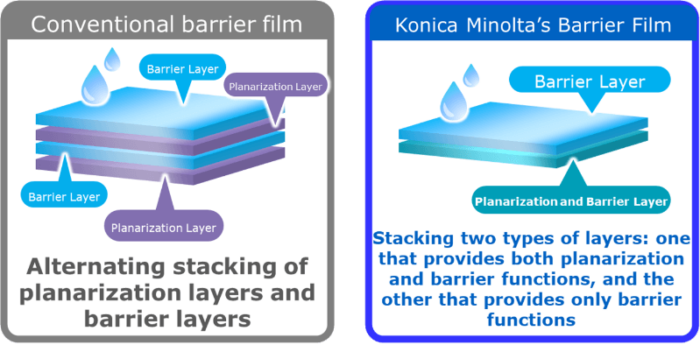
Fig. 1 Conventional Barrier Film vs. Konica Minolta’s Barrier Film
■Functions / Features / Applications
Optimizing the proprietary platform technology (“planarization + barrier layer” × “barrier layer”) for solar cell applications resolves durability issues while improving manufacturing efficiency and reducing cost. This enables both extended lifetime and mass producibility for perovskite solar cells requiring lightweight and flexibility. In a previous technology report on applications for organic EL lighting1), a 2,000-hour storage test at 60°C and 90% relative humidity demonstrated suppression of device degradation. This result indicates that the barrier film suppresses ingress of moisture and oxygen over extended periods. By leveraging long-established film manufacturing know-how, facilities, and proprietary deposition technology, Konica Minolta can build a stable supply system and contribute to lifetime extension in outdoor and high-temperature/high-humidity environments, including perovskite solar cell applications.
■Future outlook
The perovskite solar cell market is expected to grow rapidly owing to the global shift toward renewable energy, and the barrier film market size is estimated to reach JPY 50–80 billion by 2035. Konica Minolta plans to begin providing mass-production samples in 2026. In line with market expansion, the company will establish a production system that meets demand, provide high-value functional materials, and aim for leading market share. Continued technological development and business expansion will support widespread adoption of perovskite solar cells and contribute to a decarbonized and sustainable society.