


1
Overview
Biomanufacturing, in which microorganisms produce valuable substances, is expected to become a core technology that enables a decarbonized society. In order to realize biomanufacturing, developing microbial strains that efficiently produce target substances (high-producing strains) is important. Although genetic engineering has established methods for creating recombinant strains, technologies that detect high-producing strains remain under development. Therefore, in this study, we developed a new system that automatically and objectively detects high-producing strains by combining hyperspectral imaging with an anomaly detection model1). By capturing production-related differences using spectral information and statistical features, we demonstrated that our system detected high-producing strains with 93% precision in the case of Escherichia coli strains that produce polyhydroxybutyrate, which is a biodegradable plastic. Overall, this technology has the potential to transform conventional microbial strain development workflows by enabling the visualization of high-producing strains.
2
Details
■Configuration
This system consists of the following components: a spectral data acquisition unit using hyperspectral imaging (HSI), a spectral feature extraction unit, an anomaly detection Artificial Intelligence model, and a visualization/judgment interface (Fig. 1).
First, numerous bacterial colonies that form on the agar medium are captured in a single shot using an HSI camera to obtain reflectance spectra in the wavelength range of 400–1000 nm. Thereafter, features are calculated for each colony using the mean reflectance intensity and standard deviation at each wavelength, and these features are input into a trained anomaly detection model. The model uses the spectral characteristics of the host strain as a reference, and scores deviations from it to be able to select high-producing strains. Given that this analysis enables nondestructive, rapid, and rational screening, it can markedly reduce the labor required for subsequent colony picking, inoculation, and cultivation operations.
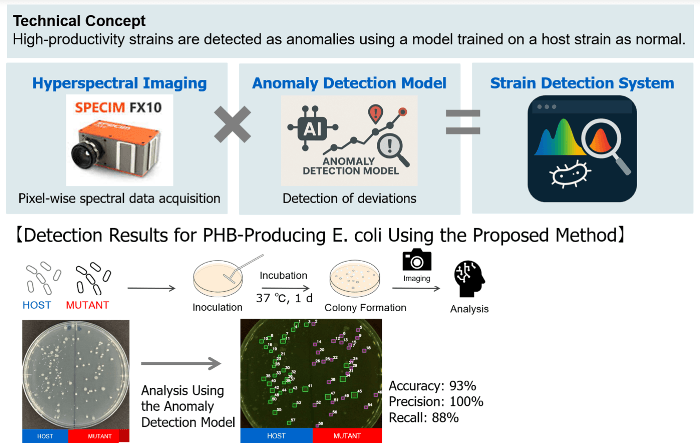
Fig. 1 Overview of the detection system that combines hyperspectral imaging and an anomaly detection model to detect high-producing bacterial strains.
■Functions / Features / Applications
A major feature of this system is that it does not require labeled training data for high-producing strains, and the model can be constructed using only the original microbial strain (host strain). In this approach, visual information, such as color, shape, and gloss of microorganisms, is quantified using HSI, and an anomaly detection model is trained by treating the host strain as normal. Consequently, applying the model enables high-producing strains to be detected as anomalies. In addition, considering that HSI can capture subtle spectral differences that are difficult to distinguish with visible light, the system can identify high-producing strains with high sensitivity and accuracy, even when differences are not apparent by our eyes.
As a demonstration experiment, approximately 200 colonies on the same agar medium were analyzed to detect Escherichia coli strains that produce polyhydroxybutyrate (PHB), a biodegradable plastic, and the anomaly detection model was applied. As a result, 93% of the colonies judged as anomalies matched PHB high-producing strains. This confirmed that the system functioned effectively during the initial screening of mutant strains. These results indicate the potential to substantially reduce the workload of researchers and greatly improve breeding efficiency.
■Future outlook
This method, which combines hyperspectral imaging (HSI) and anomaly detection artificial intelligence (AI), is applicable not only to microorganisms but also to microalgae and plant breeding. In the future, we plan to advance this work to a more versatile breeding-support platform. This will entail developing automatic calibration tailored to spectral characteristics based on medium and species, applying dimensionality reduction and optimizing features for multiwavelength data, and integrating colony detection processing. These efforts are expected to improve microbial breeding efficiency and advance biomanufacturing.