

1
Overview
In recent years, events that pose risks to raw material procurement have become more diverse and frequent, affecting the entire supply chain. Procurement risks include, for example, production discontinuation, export controls, natural disasters, and changes in the international situation. The procurement department manually collects global news that may indicate such risks; however, this work is highly dependent on individuals, and challenges remain in terms of information coverage and timeliness.
In this report, we propose a multi-agent system (MAS) that automatically collects news containing procurement risk information and determines the importance of each news item.
This MAS is an LLM-based multi-agent system1) composed of multiple AI agents incorporating a large language model (LLM).
The proof-of-concept (PoC) results demonstrate approximately a 96% reduction in workload compared with the conventional approach. In addition, we confirmed concrete actions, such as conducting interviews with suppliers, triggered by news distributed by this MAS.
2
Details
■Configuration
This multi-agent system (MAS) has two configurations, depending on the news acquisition route. One is the news-release configuration, which targets suppliers’ corporate news releases. The other is the keyword-search configuration, which searches the web for news using predefined keywords.
The flow for each configuration and the agent configuration within the MAS are as follows. The Proxy Agent acts on behalf of the user and coordinates dialogues with other agents (Fig. 1).
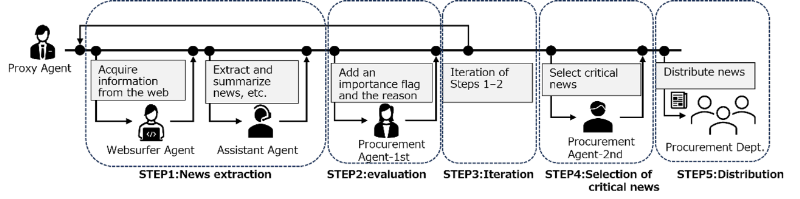
Fig. 1 Processing flow of the multi-agent system
STEP1: News extraction
<News-release configuration>
The Websurfer Agent acquires information from web pages on which suppliers’ news releases are posted. The Assistant Agent then extracts, summarizes, and translates news from the acquired webpage content.
<Keyword-search configuration> Using a news search API, related news is retrieved based on predefined keywords.
STEP2: News evaluation
Procurement Agent-1st assigns a flag according to the importance of each acquired news item and adds the reason for the assigned flag.
Procurement Agent-1st is provided, via prompts, with the procurement department’s knowledge and know-how.
STEP3: Iteration
STEP1 to STEP2 are executed for all suppliers and keywords subject to investigation.
STEP4: Selection of critical news
Using past critical news and the rationale for why those news items were determined to be important, Procurement Agent-2nd updates the assigned flag to the highest-priority level for news items determined to be particularly significant.
STEP5: Distribution
The final news list is distributed to the procurement department.
■Functions / Features / Applications
In a three-month in-house proof of concept (PoC), we achieved approximately a 96% reduction in workload. Reviewing the news list generated by the system requires approximately 0.25 hours per day, whereas manually collecting comparable news and determining its importance requires approximately 6 hours per day.
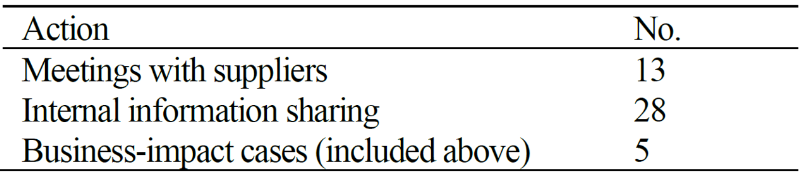
In addition, during the PoC period, concrete actions such as those shown in Table 1 were taken in response to news notified by this system. Because the system enables early detection of risk information, prompt responses became possible.
Table 1 Number of actions occurring during the PoC period
■Future outlook
Going forward, we aim to evolve this system into a partner-type AI that not only extracts and presents risk-related news but also supports users in deriving specific response measures and decision-making. In this way, we seek to establish a mechanism that consistently supports the entire process from early detection to response for procurement risks.
■ Source
This report is a re-edited version of the content of the proceedings paper2) from the 2025 Fall Research Presentation Meeting of the Operations Research Society of Japan.