


1
Overview
The Inorganic Analysis Team is responsible for environmental compliance analysis in addition to materials analysis supporting company-wide products. To support compliance with the Restriction of Hazardous Substances (RoHS) Directive, we obtained International Organization for Standardization/International Electrotechnical Commission 17025 (ISO/IEC 17025) accreditation in 20081). For environmental compliance analysis, we mainly conduct qualitative and quantitative analyze of heavy metals and halogens. We ensure accuracy through third-party audits, such as ISO/IEC 17025 laboratory accreditation, and through proficiency testing, since reliability is critical in this analysis.
We possess strong technical capabilities in trace metal analysis and halogen analysis developed during the silver-halide photographic business. During accreditation maintenance activities, we also introduced new techniques to achieve both improved efficiency and assured accuracy. This report introduces these techniques, including those used for halogen analysis, and describes proficiency tests used to verify their validity.
In addition, analytical techniques established through these activities enabled participation in collaborative experiments for value assignment and stability evaluation of commercially distributed certified reference materials. We will also report on these activities.
2
Details
■Configuration
For heavy-metal analysis in environmental compliance, we primarily employs acid digestion using a sealed microwave digestion system followed by inductively coupled plasma mass spectrometry (ICP-MS).
For halogen analysis, various instruments are used depending on the sample, including ion chromatography (IC), wavelength dispersive X-ray fluorescence spectrometry (WDX), inductively coupled plasma spectrometry (ICP), and titration. For environmental analyses such as flame retardants and per- and polyfluoroalkyl substances (PFAS), the combustion method is mainly used as a pretreatment.
■Functions / Features / Applications
1. Heavy metal analysis for environmental compliance
To improve accuracy, we add the internal standard directly to the digestion vessel after microwave digestion and maintains a fixed dilution regardless of concentration. A wide-range calibration curve is advantageous because environmental compliance samples are unknown. Performing evaluation in a single measurement using a wide-range calibration curve also reduces tools and workload. To satisfy these requirements, we use a relatively wide-range calibration curve that enables quantification from 1 ppb to 40 ppb. In instrumental analysis, measurement variation generally increases at lower concentrations; therefore, using a wide-range calibration curve reduces quantification accuracy at the low-concentration region. To ensure accuracy across the entire quantification range, we examined applying the weighted least-squares method. ISO/IEC 17025 requires calculation of uncertainty as a requirement. Because few publications discuss weighted uncertainty, we calculated it using Eq. (1) with reference to reports by Shikakume et al.2)3).
Two approaches to uncertainty estimation are used: bottom-up and top-down.
For the bottom-up approach, uncertainty is calculated for each measurement because calibration-curve uncertainty exceeds other factors.
For the top-down approach, uncertainty is calculated from past measurements of reference materials.
After comparison, the larger value is adopted. This assigns uncertainty reflecting actual conditions without over- or underestimation (Fig. 1).


Fig. 1 Example measurement of a certified reference material (Cd)
2. Halogen analysis for environmental compliance
For halogen analysis required for environmental compliance, we mainly use combustion ion chromatography. As an example of analysis difficult with general electrical conductivity detection(ECD), Fig. 2 shows measurement of trace bromine in polyvinyl chloride (PVC). To eliminate interference from the large amount of chlorine present, quantification is performed using ultraviolet detection(UVD).
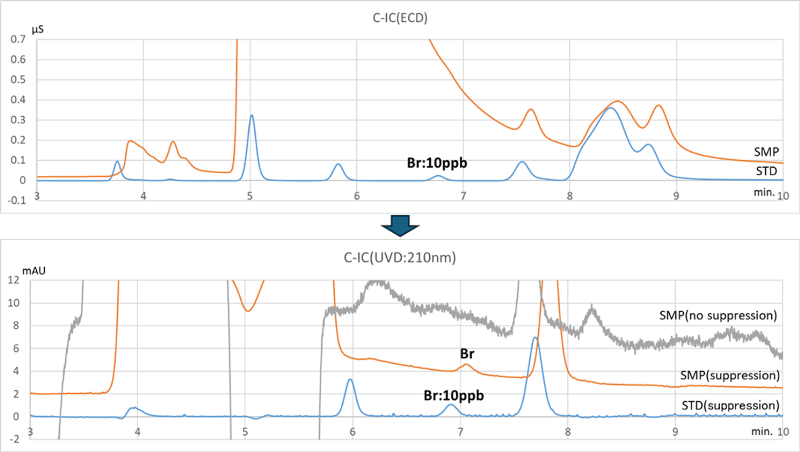
Fig. 2 Example measurement of trace bromine in PVC (combustion ion chromatogram)
3. Participation in proficiency testing and collaborative experiments
To monitor competence and perform interlaboratory comparisons, we continuously participate in proficiency tests organized by The Japan Society for Analytical Chemistry and the China NIL Research Center for Proficiency Testing. We have achieved top-level performance across low to high concentrations (Fig. 3).
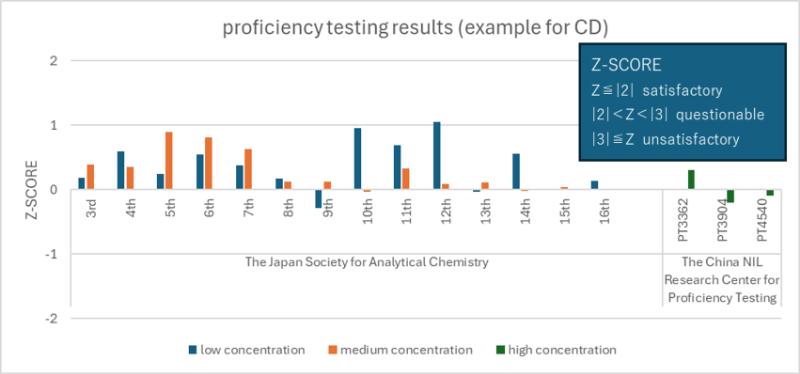
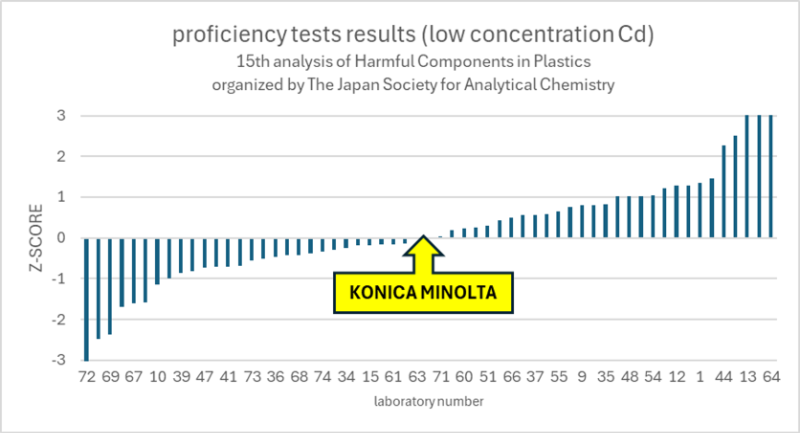
Fig. 3 Proficiency testing results
Based on proficiency test performance, The Japan Society for Analytical Chemistry invited us to participate in collaborative experiments, and we have participated seven times, including mini collaborative experiments. We make a significant impact on society through providing consistently highly accurate results (Table 1).
Table 1 Record of participation in collaborative experiments

■Future outlook
Based on highly accurate chemical analysis techniques cultivated through analysis of photographic materials, the Inorganic Team obtained ISO/IEC 17025 laboratory accreditation. Techniques and knowledge gained through maintaining accreditation contribute to environmental compliance and in-house product development. Participation in collaborative experiments also contributes to society. We will continue providing reliable analyses that support product development and customer safety.