
 Search within the site
Thin-film, high-barrier technology refined through OLED lighting enables both longer service life and mass production for next-generation solar cells
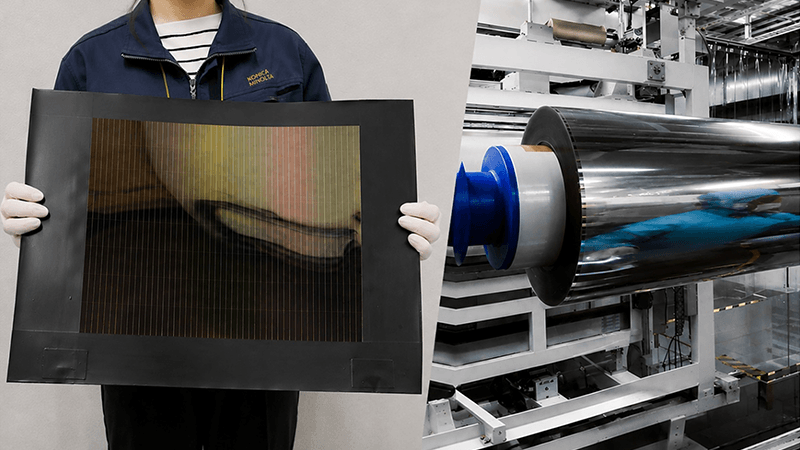
\Our expert team handles inquiries
on technical partnerships and joint research./
Under Japan’s GX (Green Transformation) policy, which aims to achieve both decarbonization and economic growth, expanding renewable energy is central to the national strategy. Solar power is expected to play a leading role, with the government’s Seventh Strategic Energy Plan projecting that installed capacity will increase to approximately three times the current level by FY2040.
However, Japan has limited flat land suitable for solar power installations, and the conventional approach of simply building more utility-scale solar plants will eventually reach its limits, partly because of the impact on landscapes and the natural environment. New devices are therefore needed to extend power generation to locations where installation has traditionally been difficult, including factory and warehouse roofs with limited load-bearing capacity, building walls and windows, and vehicle bodies and other mobility applications.
Originating in Japan, perovskite solar cells are attracting global attention as a leading candidate for such applications. They offer conversion efficiencies comparable to or higher than those of silicon solar cells while also being thin, lightweight, and flexible. They are reported to be about one-twentieth as thick and one-tenth as heavy as conventional panels and, under low-light conditions, to generate up to twice as much electricity as silicon solar cells. Japan also has a resource advantage for domestic production, ranking second worldwide in iodine production and first in iodine reserves. Iodine is a primary raw material for these cells.
However, perovskite solar cells have critical weaknesses, including sensitivity to moisture. Even slight moisture ingress can break down the crystal structure of the perovskite material in the power-generating layer, rapidly degrading performance. Heat-induced degradation of the crystal structure is another challenge. Solar cells must remain exposed to harsh outdoor environments for long periods. Widespread deployment will require durability over 20 to 30 years. The service life of current perovskite solar cells is reported to be around 10 years, compared with approximately 20 years for existing silicon solar cells. In addition to improving durability, manufacturers must establish production technologies that can consistently produce high-efficiency modules at scale. This remains a major barrier to market development.
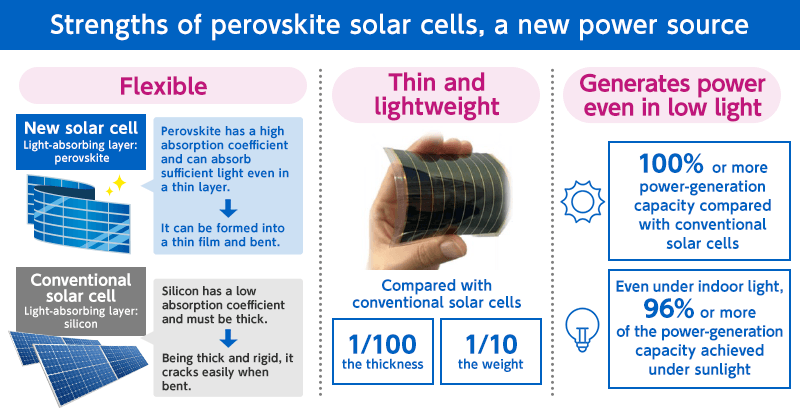
The key to protecting against moisture is the barrier film, or encapsulant, that shields the power-generating layer from the external environment.
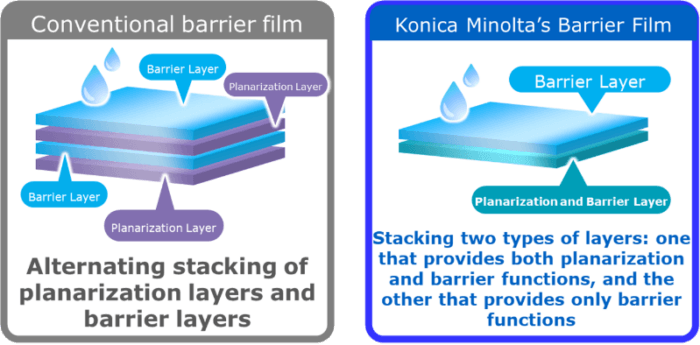
Typical barrier films achieve high moisture resistance by alternately laminating multiple planarization layers, which fill surface irregularities and microscopic holes in the substrate, with barrier layers that prevent moisture and oxygen ingress. However, achieving high barrier performance in this way inevitably increases the number of layers. Additional layers complicate manufacturing and increase costs. They also make the film thicker, reducing transparency and flexibility and increasing the risk of cracking. For solar cells, whose primary function is to capture sunlight, reduced transparency is a critical disadvantage.
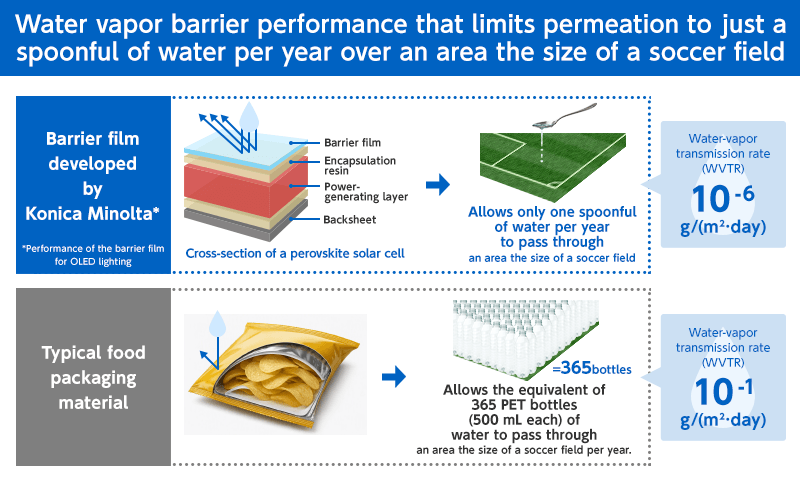
Konica Minolta’s barrier film technology challenges this conventional approach. Using proprietary deposition technology, the company has successfully combined two types of layers: a “planarization and barrier layer,” which integrates functions that were previously provided by separate planarization and barrier layers, and a dedicated barrier layer. This simplified structure delivers high barrier performance with fewer layers, providing strong moisture resistance and durability in a thin film.
To illustrate this performance in familiar terms, the film’s water-vapor barrier is so effective that it would allow only about one spoonful of water to pass through an area the size of a soccer field over an entire year. This ultra-low permeability helps extend the service life of perovskite solar cells.
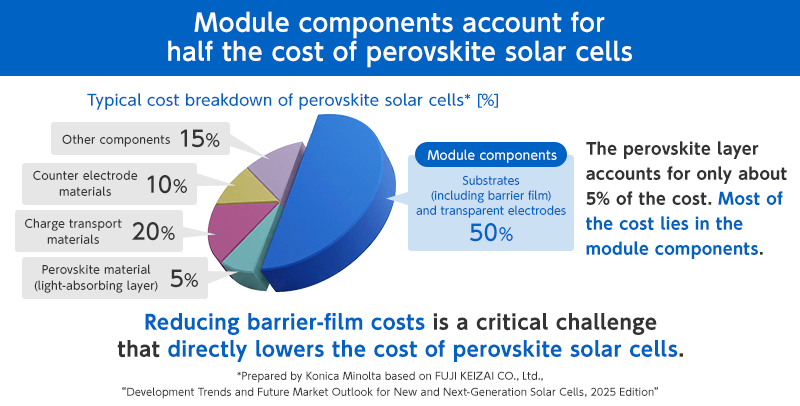
This tendency is particularly pronounced in film-type perovskite solar cells. Power-generating materials are reported to account for less than 30% of the total cost of glass-type cells. In film-type cells, transparent electrodes and barrier films, including their substrates, account for much of the cost outside the power-generating layer. In other words, regardless of improvements in cell performance, the overall product will not be competitive unless barrier-film costs are reduced. The technologies and production systems used to lower these costs will therefore be critical to widespread adoption.
The international metric commonly used to quantify cost competitiveness is the levelized cost of energy (LCOE), calculated over a system’s service life. It is defined as the total lifetime cost of a power-generation facility divided by the total electricity generated over its lifetime. The Ministry of Economy, Trade and Industry’s “Next-Generation Solar Cell Strategy” (November 2024) establishes phased LCOE targets of JPY 20/kWh in 2025, JPY 14/kWh in 2030, and JPY 10 to 14/kWh or less in 2040, when the technology is expected to become economically self-sustaining.
LCOE improves when production costs in the numerator decrease and lifetime electricity generation in the denominator increases. Thus, the longer service life and lower cost required of barrier films directly affect both sides of the LCOE equation.
Konica Minolta’s strength lies in its ability to address both sides of this equation. The company has a strong technological foundation for achieving high barrier performance and can optimize the balance among durability, transparency, and cost to meet customer specifications. Its value proposition is the ability to design and supply cost-effective, high-barrier films tailored to customer requirements.
Konica Minolta’s strength lies in its ability to address this equation head-on. First and foremost, we possess solid technology for achieving high barrier performance, and on that foundation, we can tune it to the optimal balance according to the specifications customers require (durability, transparency, and cost). Our value proposition is the ability to design and provide “cost-effective high-barrier films” tailored to customer requirements.
How did Konica Minolta develop such advanced moisture-barrier technology? The answer lies in the company’s technological history.
The first source is the ultra-high water-vapor barrier technology developed for the organic light-emitting diode (OLED) lighting business. OLED devices are also extremely sensitive to moisture and oxygen, and Konica Minolta developed proprietary high-barrier films to extend their service life. Although the OLED lighting business did not fully establish a market, the moisture-protection technology developed through that effort remains valuable. The company is now applying this expertise, including experience with outdoor installations, to perovskite solar cells.
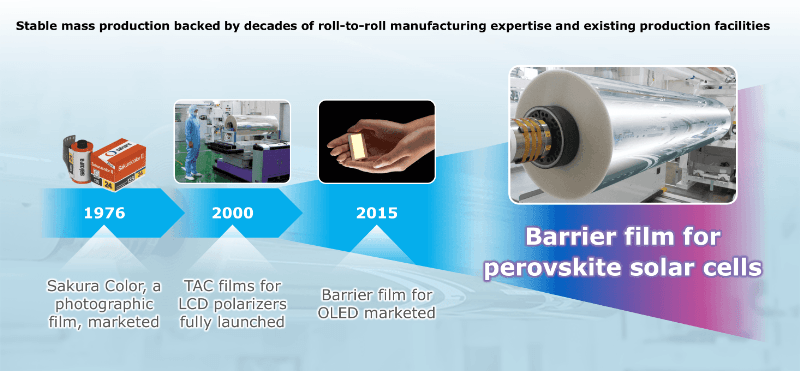
The second source is roll-to-roll (R2R) deposition technology, which has evolved continuously from photographic film, one of the company’s founding businesses, to the triacetyl cellulose (TAC) films used in liquid-crystal displays. Over many years, Konica Minolta has refined the technologies, equipment, and other assets required to deposit uniform coatings continuously and at high speed on long rolls of film.
The third source is the manufacturing technology and production system that take these innovations beyond the laboratory and enable mass production with consistent quality. Even outstanding performance cannot lead to widespread deployment unless products can be supplied reliably and at scale. With facilities capable of producing long rolls of film at consistent quality and extensive mass-production expertise, Konica Minolta is well positioned to support the commercialization of perovskite solar cells from the materials side.
Based on this conviction, Konica Minolta aims to achieve the leading market share in barrier films for perovskite solar cells by 2035 and plans to begin supplying mass-production samples in 2026.
This technology is supported by two main pillars. The first is film configuration design and deposition technology that achieves high barrier performance with fewer layers. The second is a production system capable of supplying it stably and in large volumes.
To maintain the long-term performance of perovskite solar cells, the protection target is clear: moisture and oxygen must be prevented from reaching the perovskite power-generating layer. Every aspect of barrier-film design supports this objective.
A barrier film relies primarily on two functional layers. The planarization layer fills fine irregularities and defects, including pinholes, on the substrate surface to create a smooth base. The barrier layer physically blocks moisture and oxygen ingress. Conventional technology improved performance by repeatedly alternating these two types of layers, but this increased the number of process steps, raised costs, and produced thicker films.
Using proprietary deposition technology, Konica Minolta has developed a “planarization and barrier layer” that integrates both functions. Combining this layer with a dedicated barrier layer achieves barrier performance equal to or greater than that of conventional films with significantly fewer layers. The simplified structure simultaneously provides thinness, transparency, flexibility, conformability to curved surfaces, and high durability. These properties make it well suited to film-type perovskite solar cells, which are defined by their light weight and flexibility.
The performance of this structure is supported by results from OLED lighting applications. A previous technology report described a 2,000-hour storage test at 60°C and 90% relative humidity, in which device degradation was prevented. These results indicate that the barrier film can suppress moisture and oxygen ingress over extended periods. For perovskite solar cell applications, the film is also expected to contribute significantly to longer service life in outdoor and high-temperature, high-humidity environments.
There is a significant gap between producing a single high-performance film and supplying it reliably at a scale that meets market demand. Many new technologies work in the laboratory but cannot be scaled for mass production. Konica Minolta’s key differentiator is that it already has the capabilities needed to overcome this barrier.
Using the R2R method established through decades of experience in the film business, Konica Minolta has the facilities and operational expertise to deposit coatings continuously and at high speed on long rolls of film. Long-length production ultimately depends on access to the necessary equipment, and the company’s established asset base provides a clear advantage.
Konica Minolta has also accumulated extensive in-house expertise spanning materials development, deposition processes, and quality control. This enables the company to build a flexible production system as market demand emerges. Its readiness to supply materials at scale is a key source of competitiveness.
\Our expert team handles inquiries
on technical partnerships and joint research./

